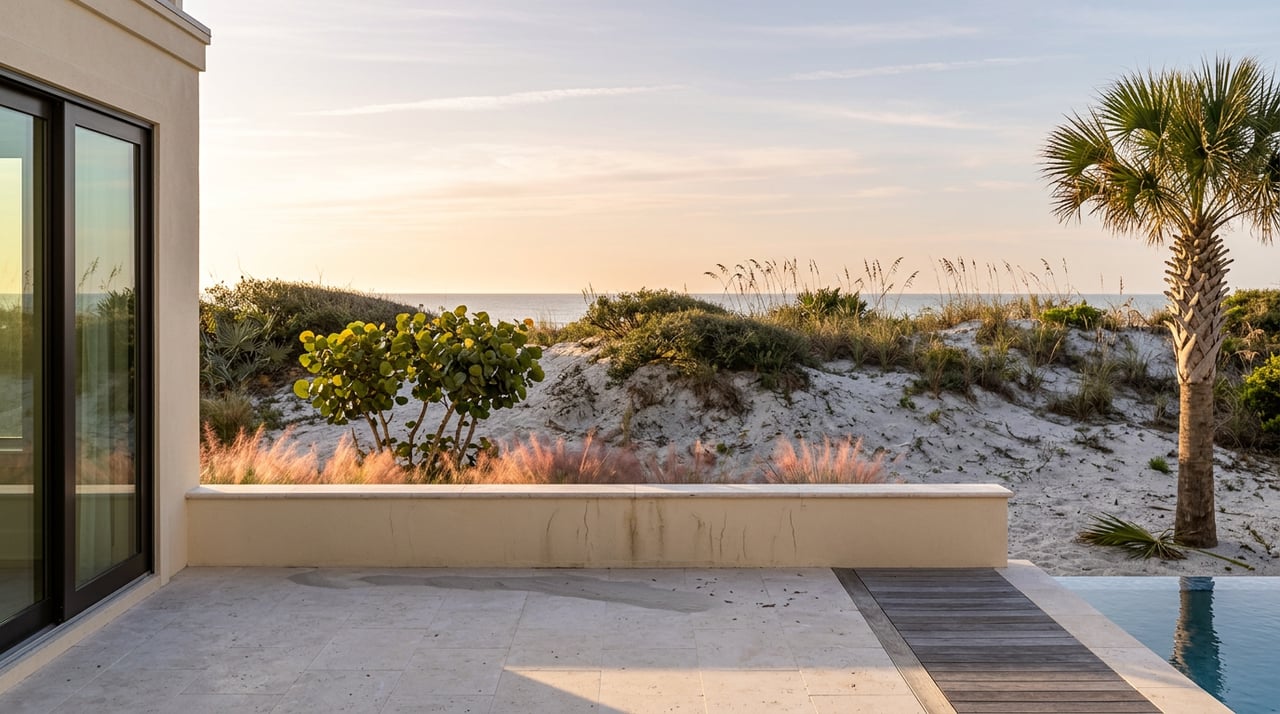
Jennifer Cranwell watched her own view change and couldn't decide if that was good news. As the beach in front of Island Beach Bar & Restaurant stabilized enough in early March to reopen the Dune Bar, she found herself fielding a strange complaint from regulars and tourists alike. The sand looked different. Flatter in some places, steeper in others, not quite the shoreline anyone remembered from a year ago. "Our tourists and people from all over Florida and essentially all over the world that come here that aren't used to the erosion, they have mixed reviews because they don't know what it used to look like and also what it's going to look like," she told a CBS12 reporter the week the bar reopened.
That single quote holds two timelines at once. One belongs to the beach: a declared emergency in February, concrete barriers on the sand, a stopgap fix, then a proper federally funded repair. The other belongs to everything built on top of the beach: a duckpin bowling alley, a $50 million resort renovation, a run of new restaurant openings, none of which slowed down or waited for the shoreline to sort itself out. These two clocks aren't running at different speeds by accident. Only one of them actually depends on what the tide does.
The Emergency Nobody Budgeted For
By early February, Fort Pierce officials weren't talking about erosion as a slow, background maintenance issue anymore. They were calling it a state of emergency. County crews installed concrete barriers near two private properties along Jetty Park Beach after determining the dune system there was close to washing out entirely. One homeowner told local news his 40-foot dock had already been carried away, and his family was packing to evacuate. St. Lucie County Commissioner James Clasby, who chairs the county's Erosion District, admitted he'd been skeptical of the concrete-barrier approach at first, calling it an unusual fix. He came around to it as a bridge measure, telling reporters he believed it was "a legitimate long-term solution to avoid doing the same thing over and over."
The bigger question was why the island was back in crisis mode so soon. The answer is buried in a detail most residents never saw reported: back in April of the previous year, the county had placed roughly 95,000 cubic yards of sand along this same stretch as an interim fix. That sand washed away within six to seven months, gone well before this year's storm season even started. A patch that size was never going to hold through a full year of Atlantic wind and tide, and the timeline proved it.
What the County Actually Budgeted to Fix It
The federally funded project meant to solve the problem properly was supposed to start in early March, bringing in an estimated 400,000 cubic yards, roughly 540,000 tons, of new sand. It didn't start on time. County officials said equipment failures on another dredging job further south in the county pushed the schedule back, and federal environmental rules tied to sea turtle nesting season dictate the order projects can run in, so Hutchinson Island had to wait its turn.
Josh Revord, with St. Lucie County's Beaches, Port, and Inlets department, put it plainly when asked why a contractor's scheduling problem became the island's problem too.
"They have the luxury of figuring out how to manage their resources so that they can fit as many projects as possible. And so that's just kind of the way the industry works. So we're somewhat beholden to their schedule."
While that larger fix waited, the county spent about $1.5 million on the emergency sand push that let the Dune Bar reopen, a stopgap distinct from the roughly $15 million renourishment contract awarded to Manson Construction for the real repair. That $15 million project is part of the South St. Lucie County Coastal Storm Risk Management effort, first built in 2018 and completed in 2022, now qualifying for federal rehabilitation after storm damage from Hurricane Nicole. It's 100 percent federally funded, with the county on the hook only for the administrative and biological monitoring work required after construction wraps, paid through the South Hutchinson Island Municipal Services Taxing Unit.
Here's the timeline, laid out plainly:
| When | What Happened |
|---|---|
| April 2025 | County places roughly 95,000 cubic yards of sand as an interim fix |
| Fall/winter 2025 | That sand washes away within six to seven months |
| Early February 2026 | Fort Pierce declares a state of emergency; concrete barriers go in near Jetty Park Beach |
| Scheduled early March 2026 | The 400,000-cubic-yard federal renourishment project is set to begin, then delayed by contractor equipment failures elsewhere in the county |
| Early March 2026 | Emergency sand push holds the high tide back; costs the county about $1.5 million |
| March 6, 2026 | Dune Bar at Island Beach Bar reopens |
| Mid-March 2026 | The roughly $15 million Manson Construction renourishment project begins, with intermittent closures across 3.3 miles of shoreline |
| Anticipated end of June 2026 | Completion target for the renourishment work |
Read the two sand figures side by side and the county's own math does the talking. A 95,000-cubic-yard patch didn't survive a single storm season. The new project is bringing in more than four times that volume. That's not a subtle upgrade, it's an acknowledgment that the previous fix was undersized for what this coastline actually needs.
The Marriott Didn't Wait for Any of This
While the county was still negotiating dredging schedules, a separate clock had already been running for a year. Local Lanes and The Hutch Market & Café celebrated their grand openings on April 17, 2025, inside the newly $50 million renovated Marriott Hutchinson Island Beach Resort, Golf & Marina. Both are the work of Rocco Mangel, the New York-born restaurateur behind Rocco's Tacos, which now has ten locations across Florida.
Local Lanes took over the historic former Wells Fargo building next to the resort and turned the old bank vault into an arcade room. Its four duckpin lanes are, as of this writing, the only duckpin bowling on Hutchinson Island, and the only alley of any kind on the Treasure Coast. The menu leans playful rather than precious: a smokehouse fish dip melt, loaded fries with charred corn and chipotle aioli, buffalo wings, and a cocktail called the Strawberry Chili, built on Hendricks gin, Cointreau, muddled strawberries, and jalapeno in a tajin-rimmed glass. There's also a house Hutchinson Island Mule, named, as the menu puts it, for the place it calls home. The Hutch, next door, handles the morning shift with coffee and grab-and-go breakfast and lunch from 6 a.m. to 4 p.m.
None of that construction schedule had anything to do with sand. It was already locked in and delivered a full year before this winter's erosion emergency even began.
The Rest of the Island Kept Building Too
The resort wasn't the only address investing while the shoreline sorted itself out. A few notable additions opened elsewhere on the island and just across the bridge in Jensen Beach:
- Restaurateur Taylor Shull, who already runs Island Pig & Fish and Island Burger and Shake, won a competitive bid against Kyle G's for a beachfront space and relaunched it as Hutchinson Island Bar & Grille, with Chef Dina now overseeing the menu across all three of his restaurants and a fresh renovation covering the paint, flooring, lighting, and furniture.
- Circa69 opened in Jensen Beach under Chef Paul Niedermann, the Hell's Kitchen Season 9 winner, built around a 1969-inspired theme with a modern kitchen behind it.
- Nonna's Italian Eatery opened across the beach from Kyle G's Prime Seafood & Steaks, offering a family-run, lower-priced alternative for a classic Italian dinner without a reservation months out.
Taken together, these openings say something the erosion headlines don't. Operators with real track records, not first-timers testing the market, chose this exact stretch of coastline to expand into during the same window it was declaring a state of emergency. That's not a coincidence born of bad timing. It's a signal about how confident local restaurateurs are in the island's long-term draw, separate from whatever the sand is doing this particular season.
What This Actually Means If You Live Here
The practical takeaway isn't complicated, but it is specific. The Manson Construction project targeted an end-of-June completion, so by late summer the heaviest disruption from this round of dredging should be behind the island. Don't assume that makes this the last word on the subject. The volume difference between last year's patch and this year's federal project suggests the county has learned something about how much sand this coastline actually needs to survive a full season, but the ocean doesn't read budget projections, and hurricane season runs well past whatever the calendar said the project would wrap.
What won't slow down is everything built around the beach rather than on it. The duckpin lanes, the new kitchens, the resort's reinvestment, all of that runs on its own calendar, funded and staffed well ahead of any given winter's storm damage. If you've lived here through more than one erosion cycle, that's probably the more useful thing to hold onto: the island's shoreline needs regular, sometimes urgent, intervention, and the island's social life has stopped waiting for permission to grow around it.
If you're weighing what that means for a home on this stretch of the Treasure Coast, from oceanfront timing to how these projects factor into ownership decisions, the Limitless LMK team works this market closely and can walk you through what's changed, including the neighborhood's current landscape. Reach out to arrange a private viewing.